Buy snelgeldlenenbinnen10minuten.eu ?
We are moving the project
snelgeldlenenbinnen10minuten.eu .
Are you interested in purchasing the domain
snelgeldlenenbinnen10minuten.eu ?
domain@kv-gmbh.de · 0541-91531010
Buy snelgeldlenenbinnen10minuten.eu ?
Are the potassium ion channels always open?
No, potassium ion channels are not always open. These channels can be either open or closed, depending on the conditions and signals in the cell. The opening and closing of potassium ion channels are regulated by various factors, including changes in membrane potential, intracellular signaling molecules, and the presence of specific ligands. This regulation allows the cell to control the flow of potassium ions and maintain proper electrical and chemical balance. **
Why do the sodium ion channels open first and then the potassium ion channels during the action potential?
Sodium ion channels open first during the action potential because they have a lower threshold for activation compared to potassium ion channels. This means that they are more sensitive to changes in membrane potential and will open more quickly in response to a depolarization. Once the sodium ion channels open and sodium rushes into the cell, causing depolarization, the potassium ion channels then open to repolarize the cell by allowing potassium to leave the cell. This sequential opening of ion channels allows for the rapid and coordinated changes in membrane potential that underlie the action potential. **

Similar search terms for Ion channels
Top-Angebote
Products related to Ion channels:
-
Xtar VC8 Fast USB Battery Charger for Li-ion BatteriesConveniently powered by a USB-C supply, the new Xtar VC8 charger accepts up to eight batteries for simultaneous charging, depending on battery type. Highly portable; it connects to PC USB sockets or solar and smartphone chargers. sing clear LCD readouts, the voltage capacity, internal resistance and cell type will be displayed. A USB wall adapter is not included in this set but can be added in the bundles section on this page, it should be noted that if you are using your own adapter, it should be of 15W so that the charger can run at peak performance. The versatile VC8 Charger has the ability to charge 1.2 Volt NiMH/NiCd AAAA, AAA, AA, A, SC and C cells as well as Li-ion/IMR/INR/ICR 3.6V/3.7V battery codes 10440, 14500, 14650, 16340, 17500, 17670, 18350, 18490, 18500, 18650, 18700, 22650, 25500 and 26650. Also, it will charge protected and unprotected 20700 and 21700 cells. Other key features include: Input: QC3.0 i.e. 5 Volts 2 Amps or 9 Volts 2 Amps Channel 1 and 8 have a peak output of 3V that can be adjusted down to 2A, 1A, 0.5A, or 0.25A for each slot. He higher the Amp, the quicker the battery will charge. At the end of the charging cycle, maximum potential is 4.2V (± 0.05V) or 1.45V (±0.1 Volts. Selects 0△V (zero delta voltage) and -△V (minus delta) modes automatically to enhance cell performance. Automatic safety protection against polarity errors, overcharging and short circuit. Flame-retardant construction. Charging current and maximum supported battery capacity Information AA/AAA 1.2V Ni-MH charging current: 0.5A × 4 (applies when charging 4 batteries) 3.6V/3.7V Li-ion charging current: 3A × 1 / 2A × 2 / 1A × 2 / 0.5A × 4 (applies when charging 1–4 batteries) Max capacity: No limit — charger detects full charge via battery voltage; display caps at 9,999mAh but full charging is unaffected. Xtar has ensured it can get as much information on the condition of your batteries as possible, to ensure high quality charging. Grade mode (through channels 1 to 4) tests the batteries capacity through charge, discharge and repeated charge cycles and storage mode will double check for correct voltage level. Dimensions: 194mm (length) x 134mm (width) x 34 millimetres (height). Net weight: 350 grammes. Recommended operating temperature range: 0° to 40°C. OPTIONAL BUNDLE: None, Inc. Wall Adapter34,95 £*Shipping: 2,49 £Secure redirect to the provider
-
Ion ion 24K Metal And Mineral Neutralizing SprayIon® 24K Metal & Mineral Neutralizing Spray is a treatment for color-treated hair that acts as a hair color primer, helping reduce mineral and metal buildup caused by hard water and environmental exposure. This lightweight spray reduces the dulling...32,99 $*Shipping: 0,00 $Secure redirect to the provider
-
Ion ion 24K Rapid Recovery Peptide Leave-In Hair TreatmentIon® 24K Rapid Recovery Peptide Leave-In Hair Treatment is a lightweight, fast-absorbing leave-in designed to reverse damage from root to tip. Powered by amino peptides for strong hair, this scientifically advanced formula helps maintain nearly 69%...28,99 $*Shipping: 0,00 $Secure redirect to the provider



-
What are the differences of the sodium ion channels?
Sodium ion channels are membrane proteins that allow the passage of sodium ions across the cell membrane. There are several types of sodium ion channels, including voltage-gated sodium channels, ligand-gated sodium channels, and leak sodium channels. Voltage-gated sodium channels open in response to changes in membrane potential, allowing sodium ions to flow into the cell. Ligand-gated sodium channels open in response to the binding of specific molecules, such as neurotransmitters, allowing sodium ions to enter the cell. Leak sodium channels, on the other hand, are always open and allow a small, constant flow of sodium ions into the cell. Each type of sodium ion channel has different mechanisms of activation and regulation, and they play distinct roles in the function of excitable cells such as neurons and muscle cells. **
-
What is the significance of voltage-gated sodium ion channels?
Voltage-gated sodium ion channels play a crucial role in the generation and propagation of action potentials in neurons and muscle cells. These channels open in response to changes in membrane potential, allowing sodium ions to flow into the cell and depolarize the membrane. This rapid depolarization is essential for the transmission of electrical signals along the cell membrane. Dysfunction of voltage-gated sodium ion channels can lead to various neurological and muscular disorders. **
-
What happens during the action potential when the Na+ ion channels are blocked?
When the Na+ ion channels are blocked, the influx of sodium ions into the cell is prevented. This results in the cell membrane being unable to depolarize properly, leading to a decrease in the amplitude of the action potential. As a result, the transmission of the electrical signal along the neuron is disrupted, affecting communication between neurons. This can lead to impaired nerve function and communication within the nervous system. **
-
Why are some voltage-gated sodium ion channels opened starting from the resting potential?
Voltage-gated sodium ion channels are opened starting from the resting potential because they are sensitive to changes in membrane potential. When the membrane potential becomes more positive, it triggers a conformational change in the channel protein, leading to its opening. This allows sodium ions to flow into the cell, depolarizing the membrane and initiating an action potential. This process is essential for the transmission of electrical signals in neurons and muscle cells. **


Why are some voltage-gated sodium ion channels opened starting from the resting membrane potential?
Voltage-gated sodium ion channels are opened starting from the resting membrane potential because they are sensitive to changes in membrane potential. When the membrane potential becomes more positive, these channels undergo a conformational change that allows them to open and allow sodium ions to flow into the cell. This influx of sodium ions depolarizes the membrane further, leading to the generation of an action potential. This process is crucial for the propagation of electrical signals along neurons and other excitable cells. **
What is an acid residue ion, an oxonium ion, and a hydronium ion?
An acid residue ion is a fragment of a molecule that remains after a hydrogen ion is removed from an acid. An oxonium ion is a positively charged ion formed by the addition of a proton to an oxygen atom. A hydronium ion is a positively charged ion formed by the combination of a water molecule with an extra proton, commonly found in aqueous solutions of acids. **
Top-Angebote
Products related to Ion channels:
-
Xtar SC2 Fast Charger for Li-ion BatteriesThe Xtar SC2 charger for Li-ion batteries has a micro-USB charging supply which makes it portable worldwide. With a double-slot design, this charger has a USB micro port that is compatible with 5.0 Volt USB connections, which includes laptops and power banks. A USB adapter is not included, if you do not own one that is 15W, you add one on in the ‘optional bundle’ section to ensure optimum performance. Supports 0.5A, 1A and 2A charging currents. So, for example, two batteries can be charged at 1A or one battery can be charged at 2A. The higher the Amp, the faster the charge. It is high quality, compact and easy to use charger and has the following features: Charging progress displayed though LED indicators. 3.6V/3.7V Li-ion charging current: 2A × 1 (applies when charging 1 battery) Max capacity: No limit — charger detects full charge via battery voltage; display caps at 9,999mAh but full charging is unaffected. Over-discharged cells can be gradually revived through the 0V battery activation feature. Has a soft start feature which when the charging cycle begins, the charging current is slowly increased to protect and prolong the batteries life. Suitable for recharging Li-ion battery size codes: 18650, 18700, 20700, 21700, 22650, 25500 and 26650 with a nominal potential of 3.6V or 3.7 Volts. OPTIONAL BUNDLE: None, Inc. Wall Adapter13,95 £*Shipping: 2,49 £Secure redirect to the provider
-
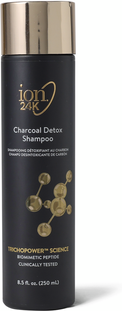
Ion ion 24K Charcoal Detox ShampooIon® 24K Charcoal Detox Shampoo is a powerful yet gentle charcoal shampoo designed to deeply cleanse hair and scalp, while repairing hair's keratin chain. This detox shampoo helps lift impurities, odors and buildup from styling products and...20,99 $*Shipping: 0,00 $Secure redirect to the provider
-
Xtar VC8 Fast USB Battery Charger for Li-ion BatteriesConveniently powered by a USB-C supply, the new Xtar VC8 charger accepts up to eight batteries for simultaneous charging, depending on battery type. Highly portable; it connects to PC USB sockets or solar and smartphone chargers. sing clear LCD readouts, the voltage capacity, internal resistance and cell type will be displayed. A USB wall adapter is not included in this set but can be added in the bundles section on this page, it should be noted that if you are using your own adapter, it should be of 15W so that the charger can run at peak performance. The versatile VC8 Charger has the ability to charge 1.2 Volt NiMH/NiCd AAAA, AAA, AA, A, SC and C cells as well as Li-ion/IMR/INR/ICR 3.6V/3.7V battery codes 10440, 14500, 14650, 16340, 17500, 17670, 18350, 18490, 18500, 18650, 18700, 22650, 25500 and 26650. Also, it will charge protected and unprotected 20700 and 21700 cells. Other key features include: Input: QC3.0 i.e. 5 Volts 2 Amps or 9 Volts 2 Amps Channel 1 and 8 have a peak output of 3V that can be adjusted down to 2A, 1A, 0.5A, or 0.25A for each slot. He higher the Amp, the quicker the battery will charge. At the end of the charging cycle, maximum potential is 4.2V (± 0.05V) or 1.45V (±0.1 Volts. Selects 0△V (zero delta voltage) and -△V (minus delta) modes automatically to enhance cell performance. Automatic safety protection against polarity errors, overcharging and short circuit. Flame-retardant construction. Charging current and maximum supported battery capacity Information AA/AAA 1.2V Ni-MH charging current: 0.5A × 4 (applies when charging 4 batteries) 3.6V/3.7V Li-ion charging current: 3A × 1 / 2A × 2 / 1A × 2 / 0.5A × 4 (applies when charging 1–4 batteries) Max capacity: No limit — charger detects full charge via battery voltage; display caps at 9,999mAh but full charging is unaffected. Xtar has ensured it can get as much information on the condition of your batteries as possible, to ensure high quality charging. Grade mode (through channels 1 to 4) tests the batteries capacity through charge, discharge and repeated charge cycles and storage mode will double check for correct voltage level. Dimensions: 194mm (length) x 134mm (width) x 34 millimetres (height). Net weight: 350 grammes. Recommended operating temperature range: 0° to 40°C. OPTIONAL BUNDLE: None, Inc. Wall Adapter34,95 £*Shipping: 2,49 £Secure redirect to the provider
-
Ion ion 24K Metal And Mineral Neutralizing SprayIon® 24K Metal & Mineral Neutralizing Spray is a treatment for color-treated hair that acts as a hair color primer, helping reduce mineral and metal buildup caused by hard water and environmental exposure. This lightweight spray reduces the dulling...32,99 $*Shipping: 0,00 $Secure redirect to the provider
-
Are the potassium ion channels always open?
No, potassium ion channels are not always open. These channels can be either open or closed, depending on the conditions and signals in the cell. The opening and closing of potassium ion channels are regulated by various factors, including changes in membrane potential, intracellular signaling molecules, and the presence of specific ligands. This regulation allows the cell to control the flow of potassium ions and maintain proper electrical and chemical balance. **
-
Why do the sodium ion channels open first and then the potassium ion channels during the action potential?
Sodium ion channels open first during the action potential because they have a lower threshold for activation compared to potassium ion channels. This means that they are more sensitive to changes in membrane potential and will open more quickly in response to a depolarization. Once the sodium ion channels open and sodium rushes into the cell, causing depolarization, the potassium ion channels then open to repolarize the cell by allowing potassium to leave the cell. This sequential opening of ion channels allows for the rapid and coordinated changes in membrane potential that underlie the action potential. **
-
What are the differences of the sodium ion channels?
Sodium ion channels are membrane proteins that allow the passage of sodium ions across the cell membrane. There are several types of sodium ion channels, including voltage-gated sodium channels, ligand-gated sodium channels, and leak sodium channels. Voltage-gated sodium channels open in response to changes in membrane potential, allowing sodium ions to flow into the cell. Ligand-gated sodium channels open in response to the binding of specific molecules, such as neurotransmitters, allowing sodium ions to enter the cell. Leak sodium channels, on the other hand, are always open and allow a small, constant flow of sodium ions into the cell. Each type of sodium ion channel has different mechanisms of activation and regulation, and they play distinct roles in the function of excitable cells such as neurons and muscle cells. **
-
What is the significance of voltage-gated sodium ion channels?
Voltage-gated sodium ion channels play a crucial role in the generation and propagation of action potentials in neurons and muscle cells. These channels open in response to changes in membrane potential, allowing sodium ions to flow into the cell and depolarize the membrane. This rapid depolarization is essential for the transmission of electrical signals along the cell membrane. Dysfunction of voltage-gated sodium ion channels can lead to various neurological and muscular disorders. **
Similar search terms for Ion channels
-
Ion ion 24K Rapid Recovery Peptide Leave-In Hair TreatmentIon® 24K Rapid Recovery Peptide Leave-In Hair Treatment is a lightweight, fast-absorbing leave-in designed to reverse damage from root to tip. Powered by amino peptides for strong hair, this scientifically advanced formula helps maintain nearly 69%...28,99 $*Shipping: 0,00 $Secure redirect to the provider
-
Ion Magnesium Blow DryerThis cutting-edge blow dryer is a revolutionary advancement in heat styling technology. This next-generation tool boasts rapid heat-up capabilities, ensuring a consistent and stable temperature for effortless and uniform styling. Infused with...84,99 $*Shipping: 0,00 $Secure redirect to the provider
-
Ion Magnesium Curling Ironion Magnesium Curling Iron is part of the next generation of heat styling. The 1 Inch barrel heats fast, maintains a stable temperature and leaves hair looking and feeling healthier, shiny and softer hair with the combination of Magnesium and...47,99 $*Shipping: 0,00 $Secure redirect to the provider
-
What happens during the action potential when the Na+ ion channels are blocked?
When the Na+ ion channels are blocked, the influx of sodium ions into the cell is prevented. This results in the cell membrane being unable to depolarize properly, leading to a decrease in the amplitude of the action potential. As a result, the transmission of the electrical signal along the neuron is disrupted, affecting communication between neurons. This can lead to impaired nerve function and communication within the nervous system. **
-
Why are some voltage-gated sodium ion channels opened starting from the resting potential?
Voltage-gated sodium ion channels are opened starting from the resting potential because they are sensitive to changes in membrane potential. When the membrane potential becomes more positive, it triggers a conformational change in the channel protein, leading to its opening. This allows sodium ions to flow into the cell, depolarizing the membrane and initiating an action potential. This process is essential for the transmission of electrical signals in neurons and muscle cells. **
-
Why are some voltage-gated sodium ion channels opened starting from the resting membrane potential?
Voltage-gated sodium ion channels are opened starting from the resting membrane potential because they are sensitive to changes in membrane potential. When the membrane potential becomes more positive, these channels undergo a conformational change that allows them to open and allow sodium ions to flow into the cell. This influx of sodium ions depolarizes the membrane further, leading to the generation of an action potential. This process is crucial for the propagation of electrical signals along neurons and other excitable cells. **
-
What is an acid residue ion, an oxonium ion, and a hydronium ion?
An acid residue ion is a fragment of a molecule that remains after a hydrogen ion is removed from an acid. An oxonium ion is a positively charged ion formed by the addition of a proton to an oxygen atom. A hydronium ion is a positively charged ion formed by the combination of a water molecule with an extra proton, commonly found in aqueous solutions of acids. **
* All prices are inclusive of VAT and, if applicable, plus shipping costs. The offer information is based on the details provided by the respective shop and is updated through automated processes. Real-time updates do not occur, so deviations can occur in individual cases. ** Note: Parts of this content were created by AI.